MODULE 7 ·
SYSTEM DESIGN

Strategy Building
& Trade Planning

This module turns knowledge into a repeatable trading system. Instead of “winging it” trade-by-trade, you build a plan that defines what you trade, when you trade, how you enter, how you exit, and what you do when you’re wrong. A strategy is only as good as its rules and how consistently it’s executed.

Lesson 7.1

Why Most Traders Never Become Consistent

Inconsistency usually comes from randomness. If entries change daily, risk changes based on mood, and exits are decided in real time, results will always be unstable. A real strategy reduces decision-making pressure by defining what matters before the trade starts.

The goal is a process that can be repeated hundreds of times with minor adjustments—not a new set of rules for every chart.
Lesson 7.2

The Trade Plan Checklist

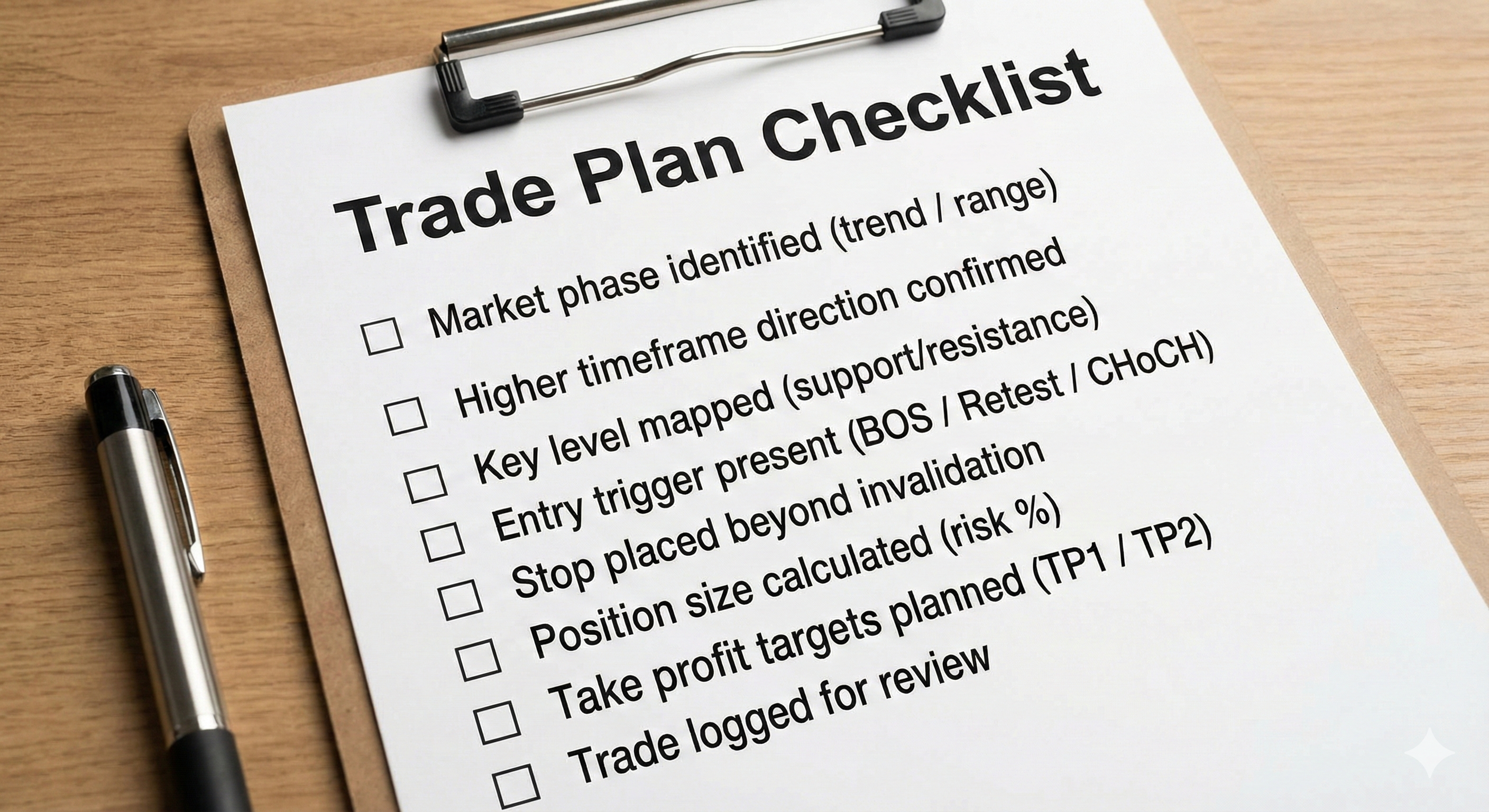
A checklist removes emotional decision-making. Before any trade is placed, confirm the same items every time: context, direction, levels, trigger, risk, and targets. If one key piece is missing, the trade is skipped.

This is how discretionary trading becomes structured and repeatable.

Trade Plan Checklist showing step-by-step checks before entering a trade
A simple checklist that turns a trade idea into a repeatable decision: context, direction, level, trigger, stop, position size, targets, and logging.
Lesson 7.3

Defining Your Setup & Rules

A setup is the exact pattern you trade. It might be a break and retest, a trend pullback into support, or a reversal after liquidity is taken. Your rules define what must be true for the setup to qualify.

Clear rules prevent you from taking “almost trades” that look tempting but don’t meet the standard.

Lesson 7.4

The Strategy Framework

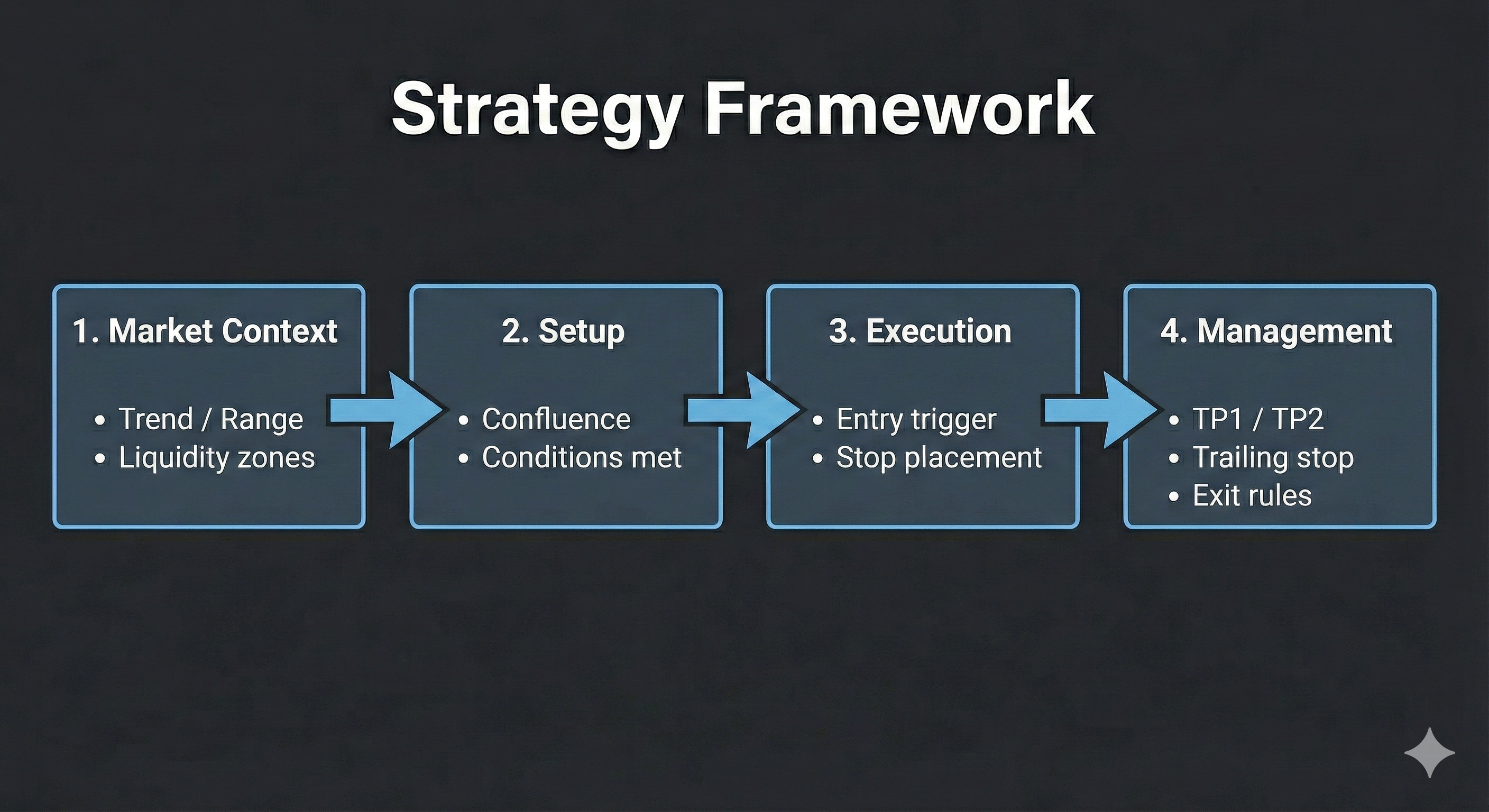
A strategy is a framework that includes market context, setup conditions, execution rules, and management rules. If any part is missing, the system breaks down under pressure. A complete framework makes decisions easier.

Your job is to build a structure that you can follow even on bad days.

Strategy framework diagram connecting market context, setup, execution and management
Strategy framework: define market context, qualify the setup, execute with clear triggers and stops, then manage exits with rules (TP1/TP2/trailing).
Lesson 7.5

Backtesting & Forward Testing

Backtesting checks whether your setup historically produces a positive outcome. Forward testing proves you can execute it in real time without breaking rules. Both matter: backtesting builds confidence, forward testing builds discipline.

The aim is not perfection. The aim is a system that performs reliably over enough trades to smooth out variance.

Lesson 7.6

The Simplest Strategy That Works

A strong strategy is usually simple: clear context, clear trigger, controlled risk, and realistic targets. Complexity often hides weak thinking. A simple strategy executed consistently beats an advanced strategy executed randomly.

Keep your process clean, repeatable, and easy to follow under pressure.