MODULE 8 ·
REVIEW SYSTEM

Journaling &
Performance Tracking

Journaling is how trading becomes measurable. This module builds a clean system for tracking setups, risk, outcomes, behaviour and mistakes. The goal is not to record trades for the sake of it, but to extract patterns, improve decision-making, and build consistency over time.

Lesson 8.1

Why Journaling Changes Everything

Without records, trading becomes memory-based. Memory is unreliable and usually biased toward emotion. A journal gives you evidence: what worked, what failed, and what you did when pressure was high.

This is where real improvement starts. If you can measure it, you can fix it.
Lesson 8.2

What to Track in Every Trade

A useful journal tracks more than P&L. It captures the exact setup, the quality of execution, the risk and the reason behind the trade. This makes it possible to separate bad luck from bad behaviour.

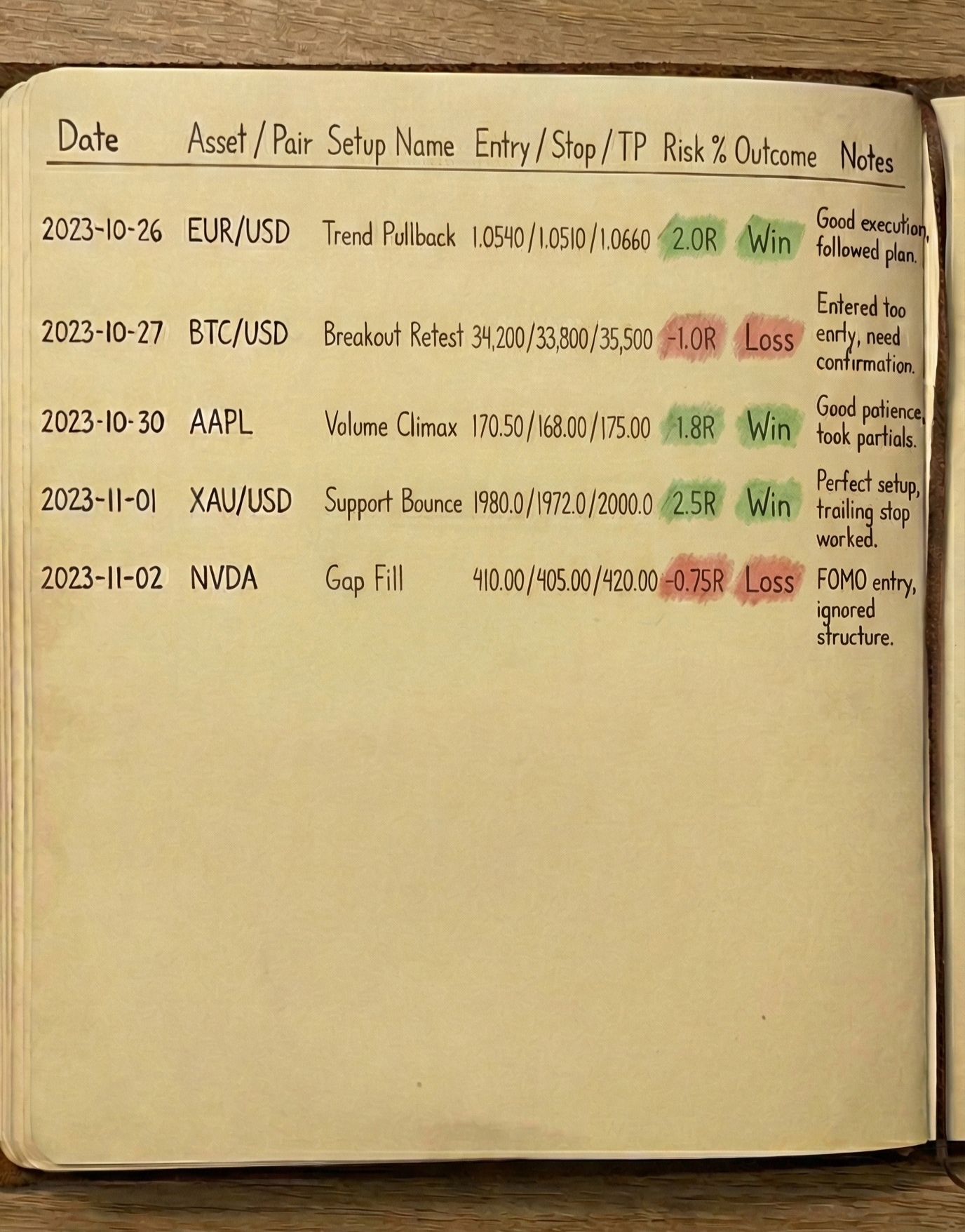
The journal should include: date, asset, setup, entry, stop, targets, risk %, outcome in R, screenshots, and notes.

Example layout of a structured trading journal with fields like setup, entry, stop, risk and outcome
Example trading journal layout: track setup, entry, stop, targets, risk %, outcome in R-multiples, plus notes on execution and behaviour.
Lesson 8.3

Reviewing Trades Without Emotion

Reviews are not about judging yourself—they are about identifying patterns. Focus on process: did the trade meet the checklist, was risk correct, and did you follow the exit rules.

The fastest improvements usually come from fixing repeated mistakes, not from finding new indicators.

Lesson 8.4

The Improvement Loop

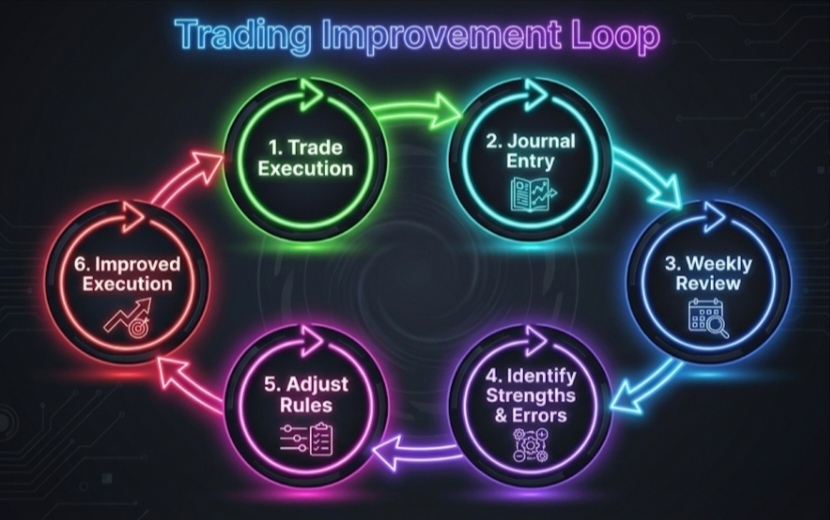
Improvement comes from a loop: execute, record, review, adjust, repeat. The loop is what turns experience into skill. Skipping review means you repeat the same errors indefinitely.

Trading improvement loop diagram showing execute, journal, review, adjust and improve
A simple performance loop: execute trades, record them, review weekly, identify mistakes and strengths, adjust rules, and improve execution.
Lesson 8.5

Key Metrics Worth Tracking

Some metrics matter far more than raw profit. Track win rate, average R, maximum drawdown, risk consistency, and how often rules were broken.

A trader with a lower win rate can outperform if average wins are larger and risk is controlled.

Lesson 8.6

Creating a Weekly Review Routine

A weekly review keeps your system tight. Pick a fixed day, review every trade, tag mistakes, identify what worked best, and adjust one thing at a time.

Over time, the compounding effect of weekly improvement becomes massive.